
- AI
- Claude
- AI agents
- Anthropic
Claude Fable 5.2 is out: should you change the model behind your AI agents?
Djtal reads the Claude Fable 5.2 release of 9 November 2026: 20% cheaper, up to 30% faster. Pricing, data retention, limits and four steps before you migrate.
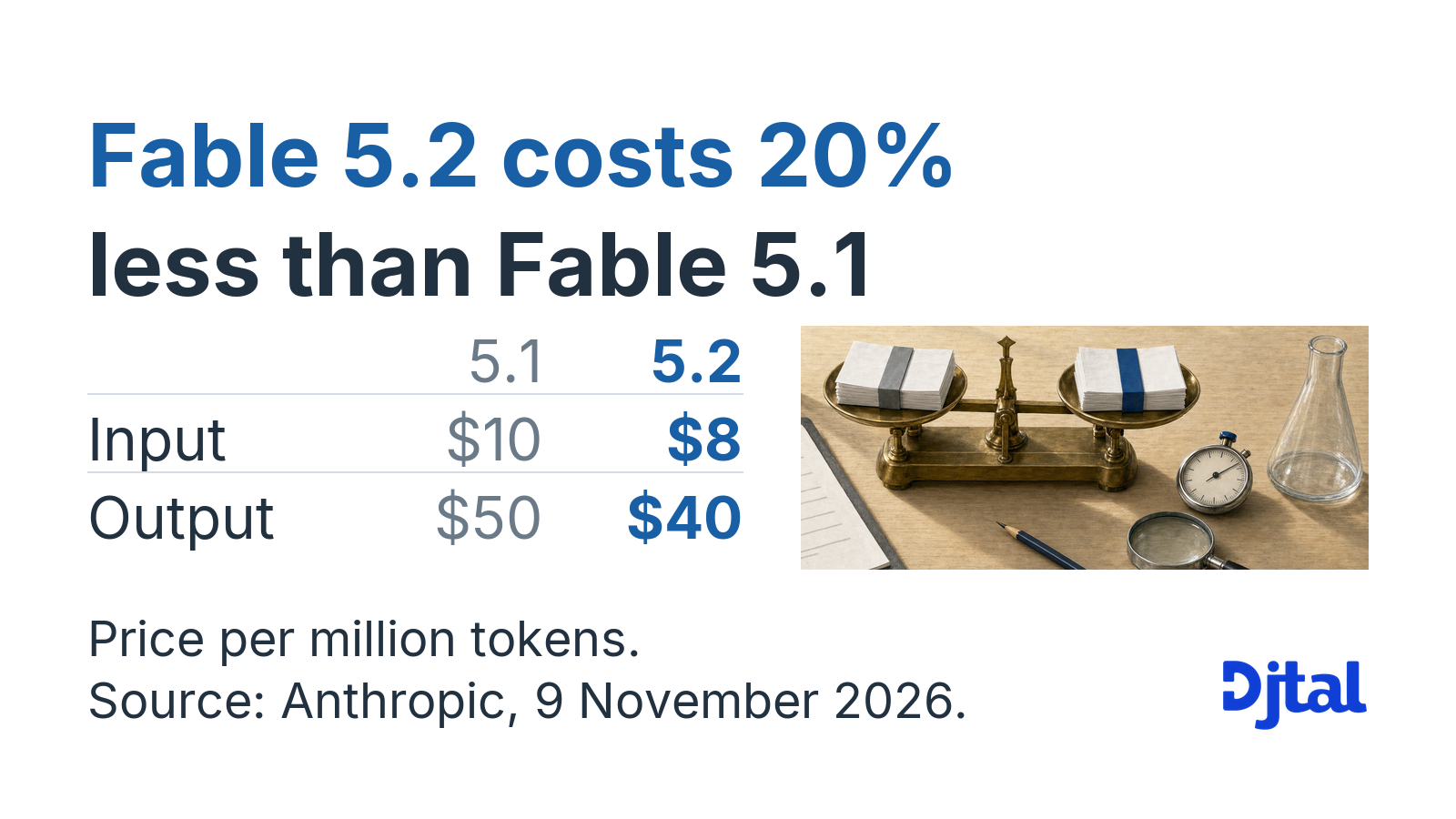
Anthropic released Claude Fable 5.2 on Monday 9 November 2026. The model costs 20% less than Fable 5.1: $8 per million input tokens and $40 per million output tokens. Anthropic says responses come up to 30% faster. For a company that runs AI agents, three questions matter more than the discount: which model to use for which task, how long your data is kept, and how to make the switch.
What changes with Claude Fable 5.2?
Prices drop by a fifth across the whole rate card.
| Per million tokens | Fable 5.1 | Fable 5.2 |
|---|---|---|
| Input | $10 | $8 |
| Output | $50 | $40 |
| Cache reads | $0.25 | $0.20 |
An optional fast mode speeds up output by up to 2.5 times, at twice the price: $16 and $80. The context window holds 1 million tokens.
Fable 5.2 has a twin, Mythos 5.2. It is the same model, at the same price. Fable 5.2 is open to everyone and blocks most cybersecurity and biology tasks. Mythos 5.2 is reserved for organisations that Anthropic has verified in those two fields.
The model is available in the Pro, Max, Ultra, Team and Enterprise plans, through the Anthropic API, and on Amazon Web Services, Google Cloud and Microsoft Foundry. Anthropic commits to keeping it available until at least 9 November 2027.
How much weight do Anthropic’s published figures carry?
Anthropic publishes its own measurements. The table shows five of them, the ones closest to the work of a business.
| Benchmark | What it measures | Fable 5.1 | Fable 5.2 | Opus 5.5 |
|---|---|---|---|---|
| AutomationBench | business processes | 31.4% | 51.4% | 42.5% |
| Remote Labor Index | knowledge work | 17.9% | 41.3% | 21.3% |
| FrontierSWE v2 | software development | 56.3% | 69.9% | 62.3% |
| OSWorld 2.1 | computer use | 83.5% | 89.3% | 87.2% |
| Humanity’s Last Exam (with tools) | knowledge and reasoning | 65.6% | 74.2% | 67.7% |
The largest gap is on business processes, with twenty more points. On knowledge work, the score more than doubles.
I read these figures with three reservations. They come from the vendor, mostly at the highest effort level. On AutomationBench, Anthropic’s own table puts Google’s Gemini 4 Carbon ahead of Fable 5.2, at 53.9%. It is the only published test where a competitor comes out in front. The external bodies that tested the model before release, including the UK AI Security Institute and METR, have not reviewed the announcement.
Anthropic also describes a prototype operating system written in eight days by more than a thousand subagents, and Fermat’s Last Theorem formalised in thirty hours. These are the vendor’s accounts. No independent verification has been published so far.
Fable 5.2 or Opus 5.5: which model for which work?
For everyday work, Anthropic recommends another of its models, Claude Opus 5.5. It costs $4 for input and $20 for output, half the price of Fable 5.2. Fable 5.2 is built for the hardest work, where Opus 5.5 is no longer enough.
The list price says little about the cost of a finished piece of work. On the FrontierCode 2.0 programming test, published by Anthropic, Fable 5.2 scores 45.3% and Opus 5.5 scores 45.5%. The two results are equivalent. Fable 5.2 gets there for about half the cost, at twice the list price. Opus 5.5 needs its deepest thinking setting to reach that score.
That setting is called the effort level. It sets how long the model thinks before it answers, on five levels from ‘low’ to ‘max’. It weighs on the bill as much as the choice of model does. The documentation advises starting at ‘high’ and running your tests again every time you change model: the same level means a different amount of thinking from one model to the next.
The right calculation is done on your own work, one deliverable at a time.
What happens to your data with Fable 5.2?
With Fable 5.2, Anthropic keeps your exchanges for 30 days for its safety checks. Some companies have a contract with no retention at all (‘zero data retention’). With this model, that option requires Anthropic’s express agreement.
Anthropic is preparing a solution, Enterprise Frontier Safeguards: the safety checks then run on data kept on the customer’s side. It is in private testing with three companies, Bridgewater, Salesforce and Stripe.
If your agents handle client files, check this point before you switch.
The model’s safeguards have a second effect. When Fable 5.2 declines a cybersecurity request, an older model, Opus 4.8, answers in its place. For biology, it is Opus 5. Anthropic reports about 55% fewer refusals than with Fable 5.1. An IT team that carries out security audits will notice it in its work.
Four steps before you change model
- Reread your agents’ instructions. They were written for the previous model. Anthropic warns that some of them cost more with the new one, or no longer have any effect. Fable 5.2 applies rules to the letter. An agent loaded with cautionary instructions will ask more often for an approval you do not need.
- Redo the effort setting. Start at ‘high’, then try the level below and the level above on your real work.
- Have your custom developments checked. Four technical changes concern teams that have programmed the connection to the model themselves. The main one: a program that edits the history of a conversation in progress now receives an error. On this point, nothing changes for agents that run through Claude Code, claude.ai or Anthropic’s Agent SDK.
- Compare blind, on your own work. Same piece of work, same file, two models, and readers who do not know which one produced what.
Experience has shown me that adopting a model on the day of its release is sometimes counterproductive. We have therefore started intensive in-house tests on real work. I will publish the recommendations within a week.
Frequently asked questions
How much does Claude Fable 5.2 cost? $8 per million input tokens and $40 per million output tokens, against $10 and $50 for Fable 5.1. Cache reads cost 20 cents, batch processing is half price, and fast mode doubles the price. The model is also included in the Pro, Max, Ultra, Team and Enterprise plans.
What is the difference between Fable 5.2 and Mythos 5.2? It is the same model, at the same price. Fable 5.2 is open to everyone, with safeguards on cybersecurity and biology. Mythos 5.2 is reserved for organisations admitted to Anthropic’s verification programmes.
Should you move to Claude Fable 5.2 straight away? If you use Fable 5.1 through the API, the 20% reduction applies as soon as you change the model identifier. For agents in production, a blind trial on a single agent is the safer first step before you change the others. For everyday work, Anthropic recommends Opus 5.5, at half the price.
Sources
- Anthropic, Introducing Claude Fable 5.2 and Claude Mythos 5.2, 9 November 2026: measurements, prices, safeguards, data retention, the vendor’s own reservations.
- Anthropic, documentation Claude Fable 5.2 and What’s new in Claude Fable 5.2: prices, context window, 30-day retention, technical changes to check, retirement date.
- Anthropic, documentation Prompting Claude Fable 5.2: effort levels, instructions inherited from an earlier model.
- AFP, 10 November 2026: same underlying model, access to Mythos 5.2.
- TechCrunch, 9 November 2026, and The Next Web, 9 November 2026: context of the release, demonstrations not verified by a third party.
Do you want to know which model to assign to which task, and who could prove it? Djtal’s AI strategy audit reviews your agents’ configuration, evidence and settings. Get in touch.
A topic worth exploring for your business?
Let's spend 30 minutes on your context and find where AI can help your business.
Speak to one of our experts