
- AI
- Claude
- AI agents
- Customer Zero
- Anthropic
Switching AI models overnight: Claude Fable 5.1 in production
Claude Fable 5.1 launched on 1 September 2026. Djtal migrated its 14 AI agent repositories that night in five steps. We cover the effort setting and the prices.
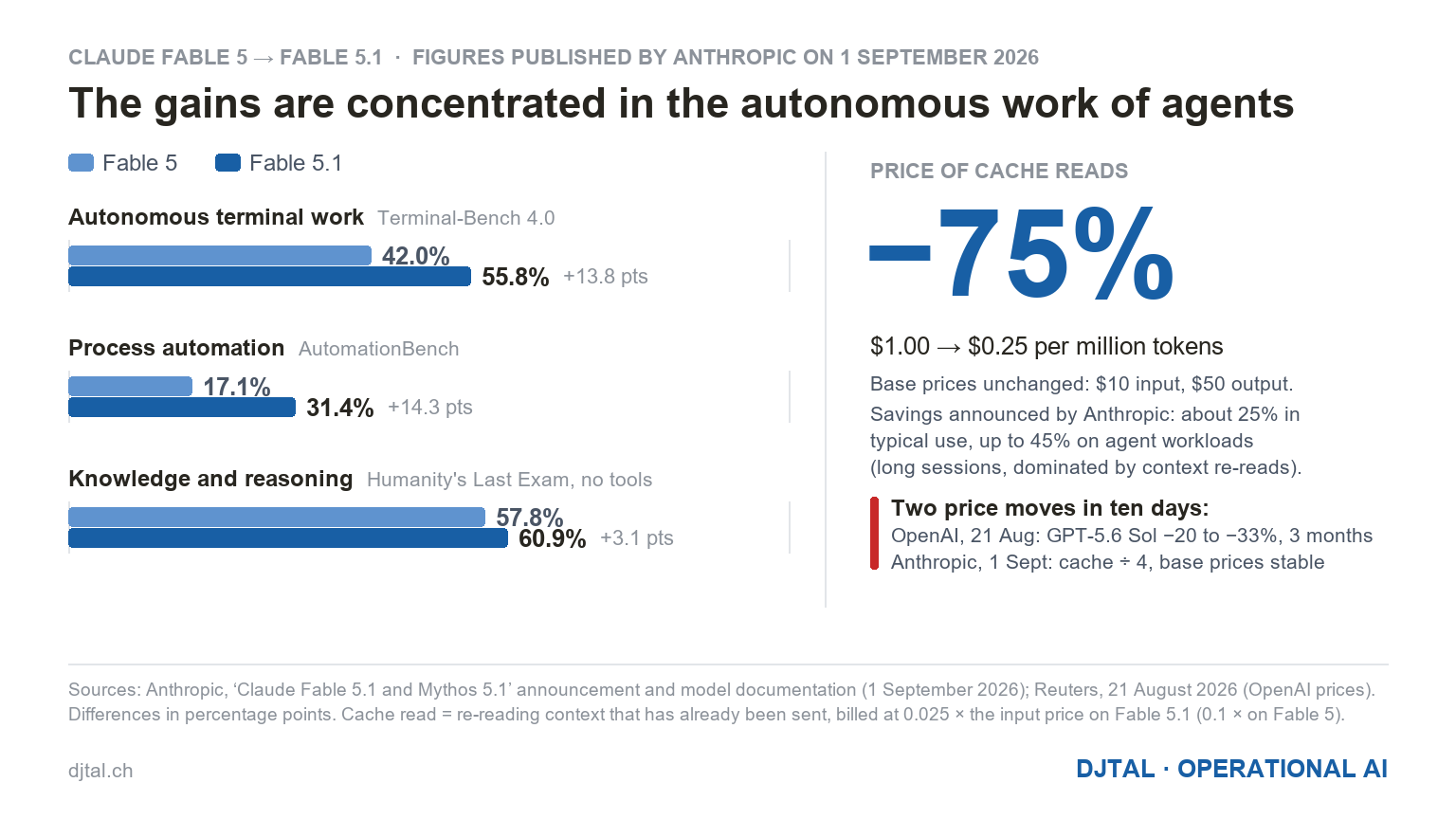
Claude Fable 5.1 (Anthropic) was released on 1 September 2026: base prices unchanged from Fable 5, cache reads at a quarter of their former price, and gains concentrated in the long, autonomous work agents do. Djtal migrated its 14 AI agent repositories that same night, in under an hour, because each agent’s model is declared in a versioned configuration that is checked at start-up. The serious work begins after the migration: re-tuning the effort settings and measuring the results.
What Claude Fable 5.1 changes, according to the published figures
Anthropic publishes its own benchmarks. Here they are as they stand, with what each one measures.
| Benchmark | What it measures | Fable 5 | Fable 5.1 |
|---|---|---|---|
| Terminal-Bench 4.0 | autonomous terminal work | 42.0% | 55.8% |
| AutomationBench | process automation | 17.1% | 31.4% |
| OSWorld 2.0 (strict) | computer use | 36.1% | 41.7% |
| GDPval-AA v2 | office work (Elo score) | 1,723 | 1,853 |
| Humanity’s Last Exam (no tools) | knowledge and reasoning | 57.8% | 60.9% |
The two biggest jumps, about 14 points each, come in long terminal work and in process automation: the daily business of agents in production. On office work the gain is real but moderate. On pure knowledge it is marginal.
On price, input stays at $10 and output at $50 per million tokens. Cache reads (re-reading context that has already been sent) fall from $1 to 25 cents per million: 0.025 times the input price, compared with 0.1 on other Claude models. Anthropic reports savings of about 25% in typical use and up to 45% on agent workloads, because a long session re-reads its context at every step.
Two more points. The cybersecurity guardrails step in about 60% less often per session in Claude Code, according to the provider. The prose is described as better, though the documentation warns that it is sometimes denser, with longer sentences and fewer paragraph breaks. We have been proofreading everything we write with that in mind since Tuesday.
How Djtal switched models in one night
Overnight from Tuesday 1 to Wednesday 2 September, at 00:40. I change the model in my working session, then ask Sofia, our orchestration agent, to roll it out. By 01:30, 14 repositories are running on Fable 5.1: Djtal’s seven agents, the deployment kit and its instance template, the six client instances and our private agents. The five steps, in order.
- A versioned configuration, read at start-up. Each agent’s model and effort level are declared in files tracked by git, and the launcher reads them every time a session opens. Without that, the model name gets copied all over the place and the change turns into a project.
- Proof the model is accepted, before any rollout. Sofia ran a real call with the new model ID and waited for the tool to accept it.
- Rollout to the usual places. Fifteen configuration files changed, deployment kit and instance template included, so that future instances start out on the right version.
- A reality check. We restarted one agent and confirmed the model from inside the session. “It should work” gave way to “it’s running”.
- The audit trail. Two commits timestamped 00:45, readable file by file. If something breaks, we know what to re-read and what to undo.
We had already made the same move in June, once in each direction: migration to Fable 5 on 11 June, then back to the previous model on 13 June when access was suspended, without losing a single project. So this was the method’s third outing.
Effort: the setting that drives cost and quality
Anthropic’s documentation is clear on this point, though few people read it: “Effort is the primary control for trading off intelligence, latency, and cost on Claude Fable 5.1. Re-run the sweep even if you already ran one on Claude Fable 5: effort level names don’t correspond to the same amount of thinking across models.” There are five levels, from “low” to “max”. “High” is the recommended starting point, and “xhigh” is meant for agentic work that runs longer than 30 minutes. Anthropic adds that Fable 5.1’s gains over Fable 5 are largest at the higher settings, and that at medium effort it roughly matches Fable 5 at lower cost.
Our rule, decided in the wake of the migration: high effort by default for every agent, the next level up for the six that run long sessions or produce high-stakes documents. We ran a first blind test the same night, on a 350-word decision note written twice with the same context. The higher-level version took 99 seconds, compared with 41. Both notes reached the same recommendation, and, without knowing which was which, I preferred the first one. One trial only. The real effect of Fable 5.1 on the quality of our written deliverables remains to be measured, and we will report it once it has been.
Two price moves in ten days
On 21 August, OpenAI cut its developer prices for GPT-5.6 Sol for three months: input from $5 to $4 per million tokens, output from $30 to $20, across the API, Codex credits and ChatGPT Work, with subscriptions unchanged (Reuters). On 1 September, Anthropic kept its base prices and cut the price of its cache reads to a quarter.
For a company running agents, that has three consequences.
- The list price per token says little about what a task costs. The effort level, the share of context re-read and the number of retries count for more. The only useful comparison is cost per deliverable, measured on your own tasks.
- A three-month promotion is a window. Use it to run comparisons, and leave your architecture as it is.
- You can follow these moves on one condition. Switching models has to be a configuration change, proven at start-up, that can be done in a night.
Frequently asked questions
Should you switch to Claude Fable 5.1 straight away? If your agents do long, autonomous work, the published figures show a clear gain at high effort. The precondition is being able to switch models in one step and to re-run the effort measurements afterwards. If that step takes you weeks, start there.
What is the effort setting on a Claude model? The effort setting on a Claude model is a five-level parameter, from “low” to “max”, that sets how much thinking and how many tokens the model spends on an answer. “High” is the recommended default, and “xhigh” is for long-running agentic work. Anthropic recommends re-running your measurements every time you change models, because the same level name means something different from one model to the next.
Has GPT-5.6 Sol become cheaper than Claude Fable 5.1? At list price, yes: $4 input and $20 output during the promotion, compared with $10 and $50. But the cost of a task depends on effort, on caching (25 cents per million tokens re-read on Fable 5.1) and on the number of retries. The comparison that matters is cost per deliverable, on your tasks. OpenAI’s promotion runs until November 2026.
Sources
- Anthropic, ‘Claude Fable 5.1 and Mythos 5.1’, 1 September 2026: benchmarks, prices, guardrails.
- Anthropic, documentation ‘What’s new in Claude Fable 5.1’: prices, cache reads at 0.025 times the input price.
- Anthropic, documentation ‘Prompting Claude Fable 5.1’ and ‘Effort’: effort levels, recommendation to re-run the sweep, density of the prose.
- Reuters, 21 August 2026, as reported by Boursorama: GPT-5.6 Sol developer price cut.
- Djtal, git log of 2 September 2026, 00:45: migration commits for the monorepo and the deployment kit.
Djtal’s AI strategy audit reviews your agents’ configuration, evidence and settings, and shows how long your organisation would take to switch models and who could prove it. Get in touch.
A topic worth exploring for your business?
Let's spend 30 minutes on your context and find where AI can help your business.
Speak to one of our experts