
- AI
- AI agents
- Customer Zero
- CRM
- Method
An AI agent in a strategy meeting: what it does before, during and after
A real case at Djtal: how an AI agent prepares a meeting, works alongside you during it, files everything afterwards and comes back sharper next time.
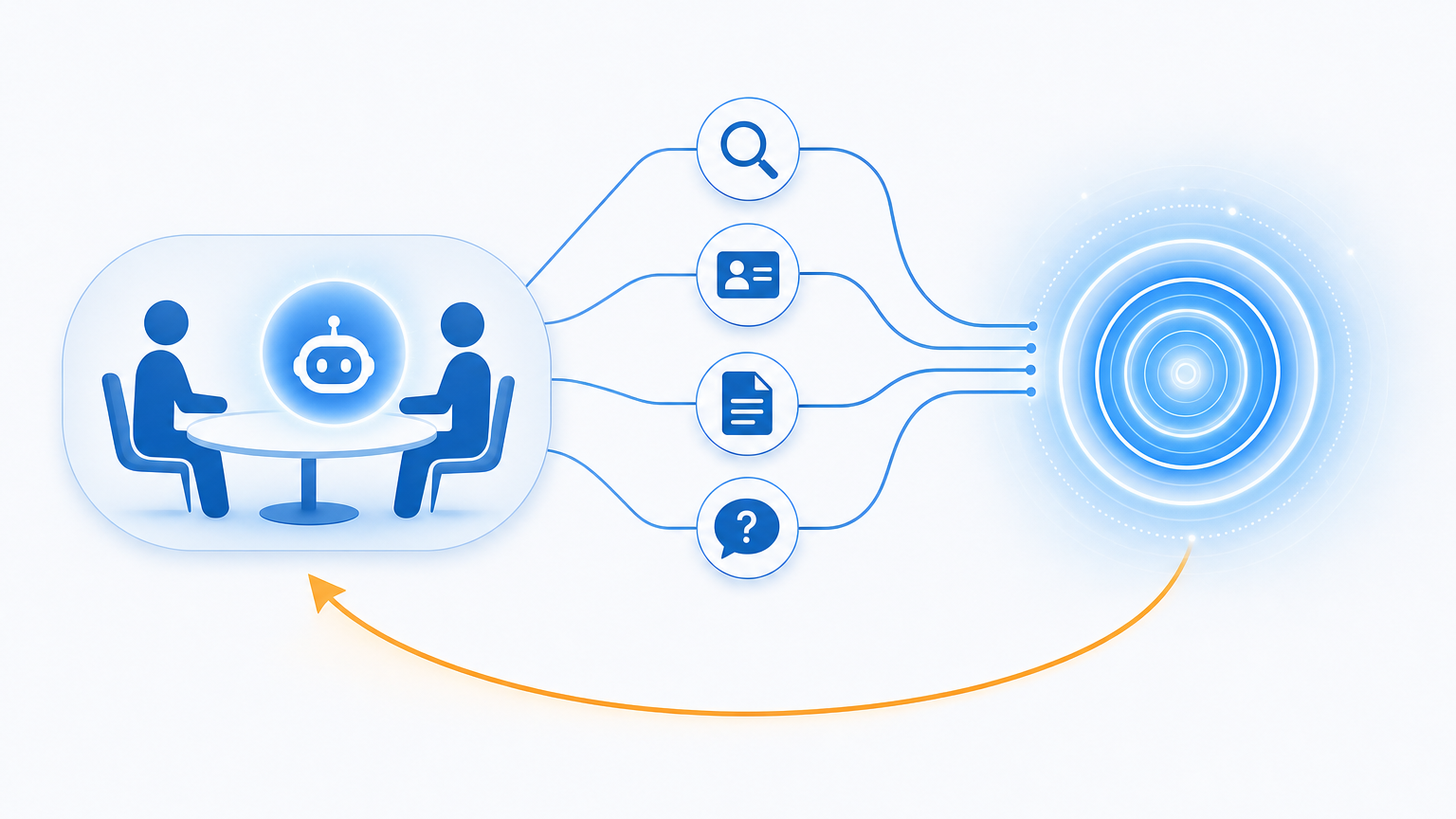
Before an important meeting with a researcher, I handed the preparation over to one of Djtal’s AI agents. It prepared the session, worked alongside me during the discussion, then wrote everything up once the meeting was over. At the next session, with someone else across the table, it did better, because it remembered the first one.
This is what an AI agent does in a strategy meeting, taken from a case we lived through in our own company.
The session was a working meeting with a neuroscientist, on a specialised subject. Cassandra, our business development agent, was with me. She is one of the seven agents we run in-house, and she attends our working sessions every week.
Before: the preparation
The day before, I give Cassandra what I already have: who I am meeting, where she works, the subject and the angles we want to bring together. Nothing extraordinary, except that this preparation is usually rushed or skipped for lack of time. This time it is done, and ready.
During: working in parallel
This is where it all happens. While I talk, Cassandra works.
I hand her a scientific study as a PDF, and she reads it. I ask her to dig into one point, and she searches the web for references that support, or contradict, what we are putting forward. She looks up the neuroscientist in our CRM and pulls out her exact job title, the team around her and the subjects that team covers.
One detail stayed with me. Midway through the session, Cassandra tells me that the person has changed her name since we last spoke, and updates her CRM record there and then. Nobody has asked her to. She spots it and does it.
Then her role shifts, and she starts contributing in her own right. She asks questions, picks up a contradiction in our reasoning and reframes a point we were skimming over. Her remarks on the substance carry weight in the discussion.
After: writing it up and filing it
Once the meeting is over, Cassandra writes the minutes. She updates the records (contacts, company, sales leads that came out of the discussion) and files everything in memory, so that it resurfaces at the right moment.
That same day, I send the neuroscientist structured feedback as a PDF. This kind of follow-up usually gets dropped for lack of time while the meeting is still fresh, and it makes all the difference.
The next session: a head start
A few days later, Cassandra joins another meeting, with a different contact. She arrives with the first session already in memory and builds on it from the outset. Her contribution is more precise and better framed.
That is what separates an agent from a one-off prompt. A prompt is gone when you close the window and remembers nothing of last time. An agent holds on to what it has seen, improves from one session to the next and moves a little closer to the company’s strategy each time. It is also what sets agentic AI apart from a chatbot.
Why it matters for a company
A strategic conversation usually loses its value at both ends: the preparation nobody has time for, and the follow-up that crumbles within the week. An agent present before, during and after plugs both leaks.
Three conditions keep it from becoming a gimmick:
- A written scope. Cassandra has a defined role and a framework. She prepares. The relationship and the decisions stay with me.
- A connection to your tools. All the value comes from the link to the CRM, the documents and the web. A disconnected agent can do little more than chat.
- Memory. Learning needs persistence; without it, each conversation forgets the one before.
Together, these three conditions turn a tool you have to reopen each time into a team member who keeps improving. Each session adds to what the agent knows, so the money spent builds into an asset.
Everything described here happened inside our own company, with Cassandra at the table. We also design custom AI agents for Swiss companies, connected to the ERP or CRM they already run, whichever it is.
Frequently asked questions
What does an AI agent do during a strategy meeting?
It works in parallel with the discussion. At Djtal, the agent reads a document handed to it, searches the web for references, finds the contact in the CRM and flags a contradiction or a point that was skimmed over. The person leading the meeting keeps the relationship and every decision.
Can an AI agent prepare for a meeting and follow up on it?
Yes. At Djtal, the day before a meeting, the agent gathers the context: the person, the organisation, the subject and the angles to bring together. After the session, it writes the minutes, updates the records and prepares structured feedback for the contact.
What is the difference between an AI agent and a prompt in a chatbot?
The difference is memory. A prompt is gone once the window closes. An agent holds on to what it has seen, improves from one session to the next and moves closer to the company’s strategy. An agent of this kind rests on three conditions: a written scope, a connection to your tools and persistent memory.
The neuroscientist had her feedback that same evening. By then we were already thinking about the next step.
A topic worth exploring for your business?
Let's spend 30 minutes on your context and find where AI can help your business.
Speak to one of our experts