
- AI
- Agentic AI
- AI agents
- Customer Zero
- Method
Agentic AI: everyone is talking about it, but what does it mean in practice?
What is agentic AI? Djtal sets out the difference between a chatbot, a single agent and a team of agents, drawing on the seven agents at work in its own company.
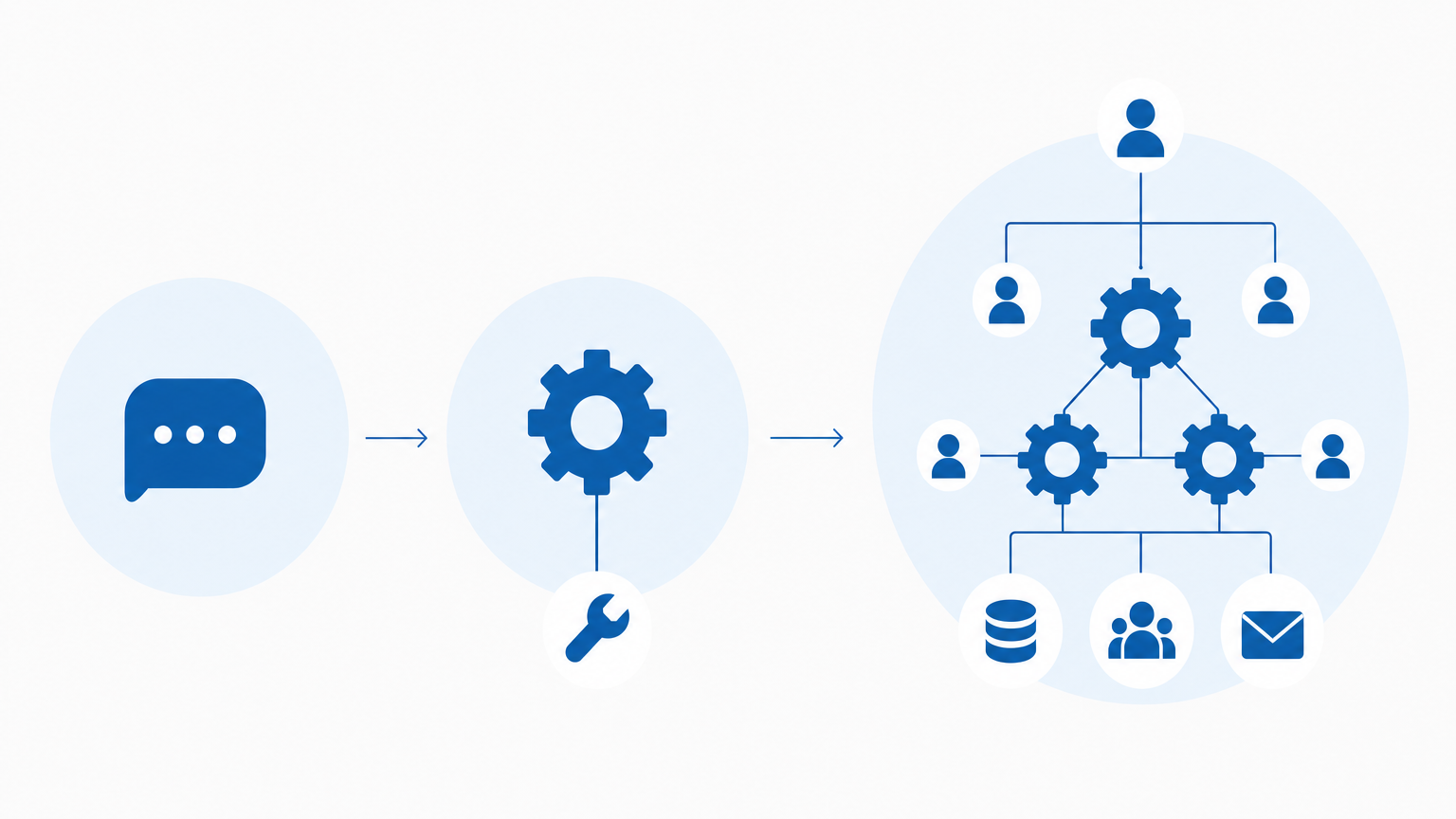
‘AI agent’. In 2026 the term appears in every sales presentation and every LinkedIn feed. Yet few people have seen agents orchestrated across an entire company.
Yesterday it was ‘copilot’, today it is ‘agent’. Behind the same word sit three very different things: the chatbot you talk to, the single agent that fills a role, and the team of agents built into the company’s systems. Telling them apart keeps you from paying for a gimmick when you thought you were buying a working tool.
Chatbot or AI agent: the first dividing line is action
A chatbot waits for your question and generates an answer. That is useful, but the result stays isolated and personal. It benefits the company only indirectly.
An agent fills a lasting role and carries out its tasks to a written brief. It looks up information, researches the market, summarises, enriches the CRM and puts the key points to you for approval.
The difference, then, is that an agent acts over the long term and gets better at its work as it goes.
The three ingredients of an agent that holds up
For an agent to hold up, three things are needed:
- A scope of action. An agent needs a precise definition of its role, its responsibilities, its skills and the framework it works within, so that the risk to the company stays under control.
- Integrated actions. It connects to the tools you already use (ERP, CRM, email) to exchange data and act in step with the systems around it.
- Human oversight. A human approves the agent’s work, corrects it and keeps control.
Remove any one of the three and the agent will be ineffective at best, and a major risk to the company at worst.
The next step: from a single agent to a team of agents
This is where agentic AI starts to produce value you can measure.
A single agent automates a series of tasks within its own lane. It is handy but limited: it sees only its own scope. Each new need calls for a new tool, disconnected from the others.
A team of agents is a different thing altogether. The agents work together: they share out the work, pass information on, leave a trail you can consult and take turns on a task that crosses several business functions. Each one is specialised, and together they work as one.
This team also becomes part of the company itself. Connected to business processes, it gives direct assistance to employees at every level, from a colleague handling a customer request to an executive preparing a decision. Assistance is available from the front line to the board of directors, without anyone needing to open a piece of software.
What the team changes
Talking to an AI has become a daily habit. Handing a task to an agent is a step few have taken. Getting a team of agents to work inside the company calls for a deep change in how the company is organised. It takes serious work, and once it is in place, it pays off.
This is where most projects stumble, and the cause is method. (I wrote about it here: 95% of AI pilots produce no measurable return.)
What this looks like at Djtal
This is the experiment we have run at Djtal, the operational AI specialist for Swiss companies, to sharpen our own competitive edge and to support our clients with first-hand knowledge. We run a team of seven agents. Each has a name, a scope, a human supervisor and written rules. They coordinate through a shared state and every action is traced. Modelled on our strategic scorecard, they support every level of the company, from day-to-day operations to the strategic thinking of senior management, where one agent prepares decisions, structures trade-offs and stress-tests directions.
They do this work every day.
Before you sign up for AI agents
Going from a chatbot to a team of agents built into the company is worth the investment.
When you are offered AI agents, three questions sort the offers. What exactly is their scope? Can they connect to your existing systems? How does the team fit into your organisation?
Further reading: what agentic AI changes when it is applied to your existing tools and what a custom AI agent would do in your company.
If you have a process in mind for agentic AI, write to me and describe it.
A topic worth exploring for your business?
Let's spend 30 minutes on your context and find where AI can help your business.
Speak to one of our experts