
- AI
- AI audit
- Strategy
- ROI
AI audit in Switzerland: what it is for, how it works, what it costs
Djtal explains the AI audit for Swiss companies: what it contains, deliverables to expect, typical fees (CHF 800 to 8,000) and questions to ask before signing.
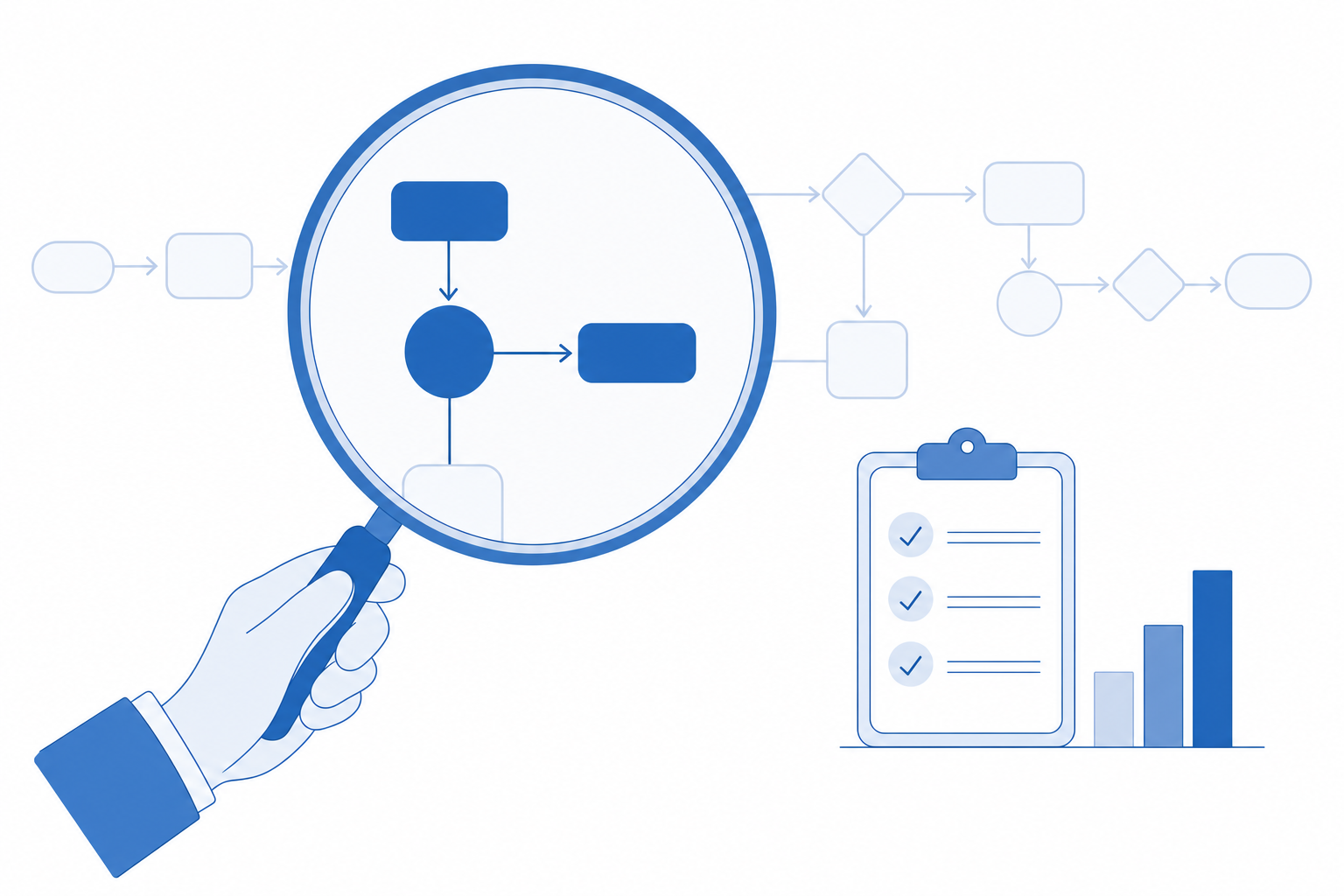
An AI audit is a structured review of where artificial intelligence can work in a company: a maturity assessment, priority use cases with costs attached, risks and a dated action plan. It typically lasts from half a day (initial scoping, from CHF 800) to two weeks (full audit, CHF 4,800 to 8,000 excl. VAT at Djtal) and ends with a deliverable that the leadership team can act on. This guide sets out what to expect from an audit and which questions separate one supplier from another. For the choice of supplier itself, see our guide to choosing an AI agency in French-speaking Switzerland.
Why audit when “everyone already uses AI”?
For that very reason. One in three Swiss SMEs uses AI (34% in 2025, AXA/Sotomo study), and 80% of Swiss internet users aged 15 to 75 now use it at least occasionally (IGEM-Digimonitor, August 2026). But use and return on investment (ROI) are two different things. According to the Swiss Data & AI Observatory (Colombus Consulting, Oracle and HEG Geneva, 2025 edition), 58% of Swiss organisations have a “basic or non-existent” AI ROI measurement. Only 35% integrate AI into their strategic plan.
An audit is there to close that gap, taking you from scattered use to a measurable return. It answers the questions every business leader asks. Where can AI help in my company? What does it cost? Is my data ready? What are the risks? What is the plan?
What a good AI audit contains
Insist on these five components. Our own audits are built on the same five.
- A maturity assessment covering data, processes, teams and governance. It covers people as well as technology, because in-house skills often hold AI projects back.
- A review of what already exists, including any AI projects already under way. A serious audit examines what you have already launched and identifies where it can be improved, as well as where new opportunities lie.
- Prioritised, costed use cases, each with a functional description, the data required, the expected return, the duration and an investment range. Three solid cases beat 15 ideas.
- A risk map covering confidentiality, compliance with the Swiss Federal Act on Data Protection (FADP), technical dependencies and the points to watch in your sector.
- A dated action plan (at Djtal, 90 days with monthly milestones), presented to the leadership team at a meeting and discussed with them openly.
One more requirement runs through all five: the report must be your property, usable with the supplier of your choice. An audit that only serves to sell the next phase is a quote in disguise.
How much an AI audit costs in French-speaking Switzerland
The market in French-speaking Switzerland falls into three kinds of offer.
- The free 30 to 60-minute assessment, offered by several firms in the region. It is a chance to get acquainted, but too short to produce a plan.
- The entry-level audit, at around CHF 800 to 850 for half a day. It is the right format for pinpointing the most promising avenues before investing more. At Djtal, the initial audit costs CHF 800 excl. VAT (4 hours).
- The structured audit, from a few days to two weeks. At Djtal, the full AI strategy audit costs CHF 4,800 excl. VAT (24 hours of work, three detailed use cases, a 90-day plan) and the in-depth cross-department audit costs CHF 8,000 excl. VAT (40 hours). Our fixed fees always state the hours involved. Expect the same transparency from any supplier.
Questions to ask before you sign
- “Who carries out the audit?” A senior practitioner who has deployed AI in production, or a consultant who has read the documentation? Ask for specific references.
- “Do you use AI yourselves?” A credible auditor tests its recommendations on its own processes. Ask to see how.
- “Can a third party carry out the plan?” If the deliverable is worthless without the follow-on work the auditor sells, be wary.
- “How do you handle our data during the audit?” Look for a non-disclosure agreement signed beforehand, secure environments and a commitment that none of your data will be used to train a public model.
- “What happens if the audit does not suit us?” Read the termination and refund terms before you sign.
The right time is before your next pilot
If your company already uses AI without a written strategy, the audit is the first step to put on your roadmap. It prevents pilots that go nowhere and focuses your resources on the use cases with a measurable return.
Our AI strategy audit applies everything above: assessment, costed use cases, 90-day plan and presentation to the leadership team. It comes with a satisfaction guarantee (if it does not fit your situation, the engagement stops at the end of Phase 1 and 50% is refunded) and no obligation to continue.
Frequently asked questions
How much does an AI audit cost in French-speaking Switzerland?
Expect CHF 800 for a half-day scoping session and CHF 4,800 to 8,000 for a structured audit lasting one to two weeks. At Djtal, the initial audit costs CHF 800 excl. VAT (4 hours), the full audit CHF 4,800 excl. VAT (24 hours, three costed use cases, a 90-day plan) and the in-depth cross-department audit CHF 8,000 excl. VAT (40 hours). The free 30 to 60-minute assessments are for making first contact; they are too short to base a decision on.
How long does an AI audit take?
Half a day for initial scoping, one to two weeks for a full audit. The timetable depends mainly on when your teams are free for interviews, so allow for three to five one-hour interviews with management and the operational teams.
Does the audit report belong to me?
It must. Insist on a deliverable you can use with the supplier of your choice, covering the assessment, costed use cases, risks and a dated plan. An audit whose conclusions only work with the follow-on work the auditor sells is simply a quote for that work.
Do we need an audit if we already use ChatGPT or Copilot?
That is the best time to do one. Your teams already use AI individually; what is usually missing is a measurable return. The audit turns scattered habits into prioritised, costed and governed use cases, and it also examines the initiatives you have already launched.
A topic worth exploring for your business?
Let's spend 30 minutes on your context and find where AI can help your business.
Speak to one of our experts