
- AI
- AI agents
- Governance
- OpenAI
- Switzerland
OpenAI Dots: three questions before you enable an always-on agent
OpenAI launched Dots, AI agents that run around the clock, on 29 September 2026. In Switzerland, access is via company accounts. Djtal sets out three questions.
OpenAI introduced ‘Dots’ on 29 September 2026: personal agents that run continuously, each with its own computer in the cloud. For Swiss users, the individual Pro subscription is excluded at launch; the agents arrive through company accounts, once an administrator enables them. A Swiss company’s first always-on agent will therefore be a management decision, and preparing it comes down to three questions: what the agent may touch, what it will cost at steady state, and who watches its work. Djtal, which specialises in operational AI, takes them in turn below.
What OpenAI launched on 29 September
According to The Next Web, 29 September 2026, each dot gets its own cloud computer, with a browser, and connects to more than 4,000 applications. You set it goals; it pursues them between conversations and is steered from ChatGPT, Slack or Teams, with SMS to follow. Dots run on GPT-6 Astra. TechCrunch, 29 September 2026 reports that an integration with Microsoft Agent 365 is under way.
The timing is worth a closer look. On 26 September, three days before the launch, OpenAI paused the training and use of its most capable models after a series of agent incidents. A provider pushing autonomy this far ships it with the brakes fitted.
In Switzerland, access is through company accounts
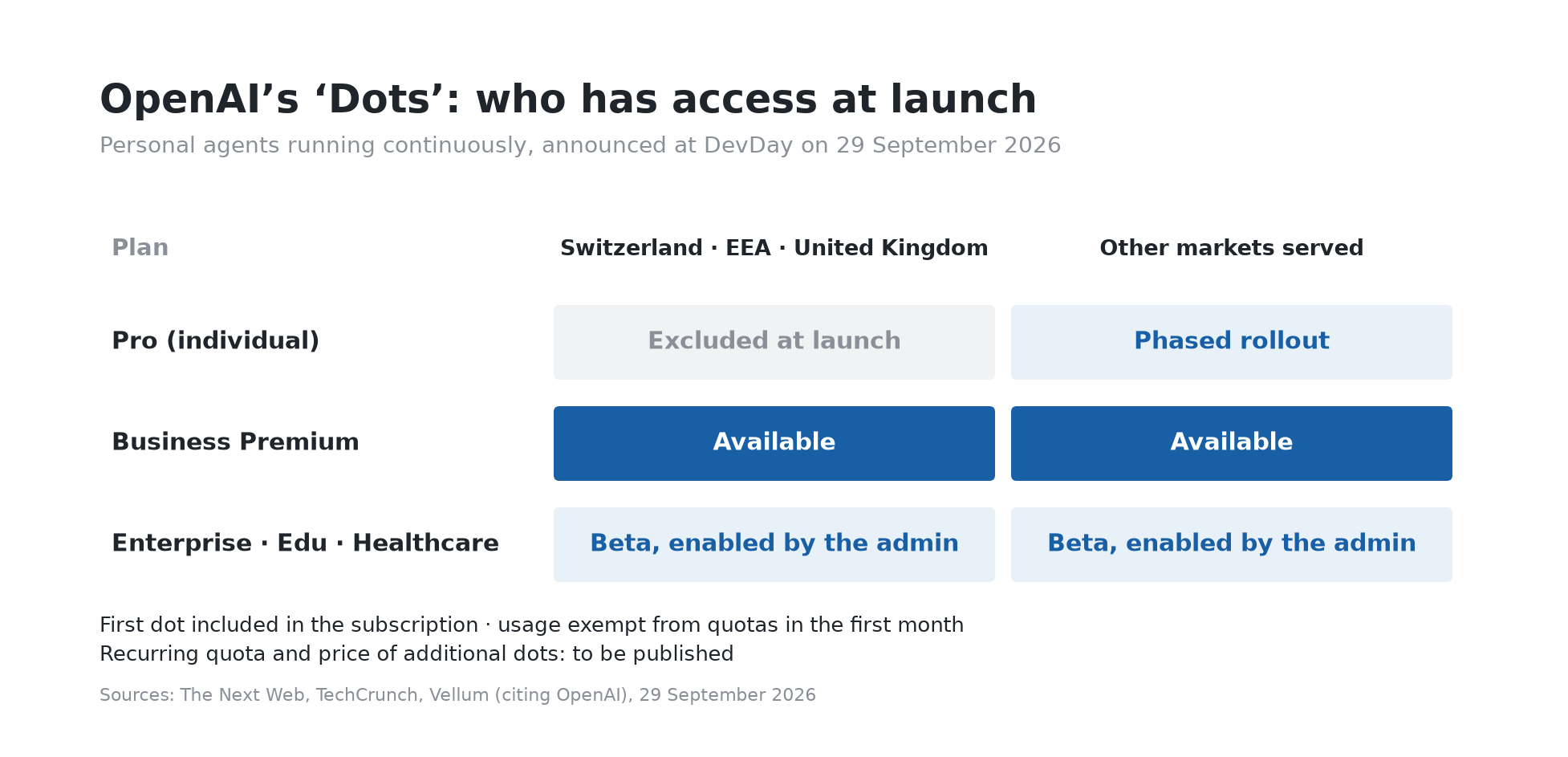
OpenAI’s Help Center gives the exact scope of the launch:
| Plan | Switzerland, EEA, United Kingdom | Other markets served |
|---|---|---|
| Pro (individual) | Excluded at launch | Phased rollout |
| Business Premium | Available | Available |
| Enterprise, Edu, Healthcare | Beta, enabled by the administrator | Beta, enabled by the administrator |
The headline the press is about to run, ‘always-on agents for everyone’, is wrong for Switzerland. Individual access has to wait; the way in is the company account, and the key is in the administrator’s hand. That distribution detail changes the nature of the decision: enabling an always-on agent is a management matter, on a par with buying new line-of-business software. Three questions come before the first click.
Question 1: what may the agent touch?
Each dot ships with default rules that separate what it does on its own from what waits for approval. Those rules are OpenAI’s, calibrated to OpenAI’s own risks. The scope is still for the administrator to set: which accounts, which data, which of the 4,000 applications. The list of permissions for an agent in production applies unchanged: one dedicated account per system, a deny list, human approval for actions that leave the company, a log that someone reads.
On 30 September, Iris, Djtal’s communications agent, prepared a LinkedIn post, with its text, image and sources. Laurent Cuénoud decided to publish it and scheduled it for 17:05 with a single click. An approval point can come down to one click, provided it was settled before the agent was enabled.
Question 2: what will it cost at steady state?
The first dot is included in the subscription, and its usage is exempt from quotas for a month. After that, OpenAI has said nothing: the recurring quota and the price of additional dots are still to be published. A company that deploys this quarter will find out the price along the way.
The trial month will give a flattering picture of the cost, since usage is unrestricted. A prudent administrator limits the pilot to one agent and one measurable task, records actual consumption over the first month, and sets a review date for the day the price is published. The budget for an always-on agent can then be set against what it replaces: a known number of hours on a named task.
Question 3: who watches the work, and who stops it?
OpenAI provides two safeguards. Each dot’s computer can be inspected at any time, and built-in monitoring can suspend it if a security problem arises. ‘Inspectable’ means someone does the inspecting. OpenAI’s monitoring protects OpenAI; an agent can stay within the security rules and still send a customer the wrong figure. What remains is to name who reviews the agent’s work, how often, and who has the authority to stop it. The containment, the named decision-maker and the incident plan complete this set-up.
An always-on agent works at night and at weekends. The question ‘who is watching?’ has a different answer on a Tuesday at 10:00 and on a Saturday at 03:00. It has to be asked for both.
Frequently asked questions
Is OpenAI Dots available in Switzerland? Yes, through business plans. OpenAI’s Business Premium plan offers Dots in every region served, Switzerland included. Enterprise, Edu and Healthcare workspaces get it in beta once the administrator enables it. The individual Pro subscription excludes Switzerland, the EEA and the United Kingdom at launch.
How much does a Dots agent cost? The first dot is included in the subscription and its usage is exempt from quotas for the first month. OpenAI will publish the recurring quota and the price of additional dots later; until then, the steady-state cost is unknown.
What is an always-on AI agent? An always-on AI agent is one that pursues goals between conversations. Each OpenAI dot has its own computer in the cloud, connects to more than 4,000 applications and is steered from ChatGPT, Slack or Teams.
Before long, an employee will ask you for an always-on agent of their own. Djtal’s AI strategy audit prepares your answer before the request arrives. Get in touch.
A topic worth exploring for your business?
Let's spend 30 minutes on your context and find where AI can help your business.
Speak to one of our experts